

When a Shopify theme stops being enough
Moving beyond templates to build better customer experiences, stronger brands, and higher-converting storefronts.
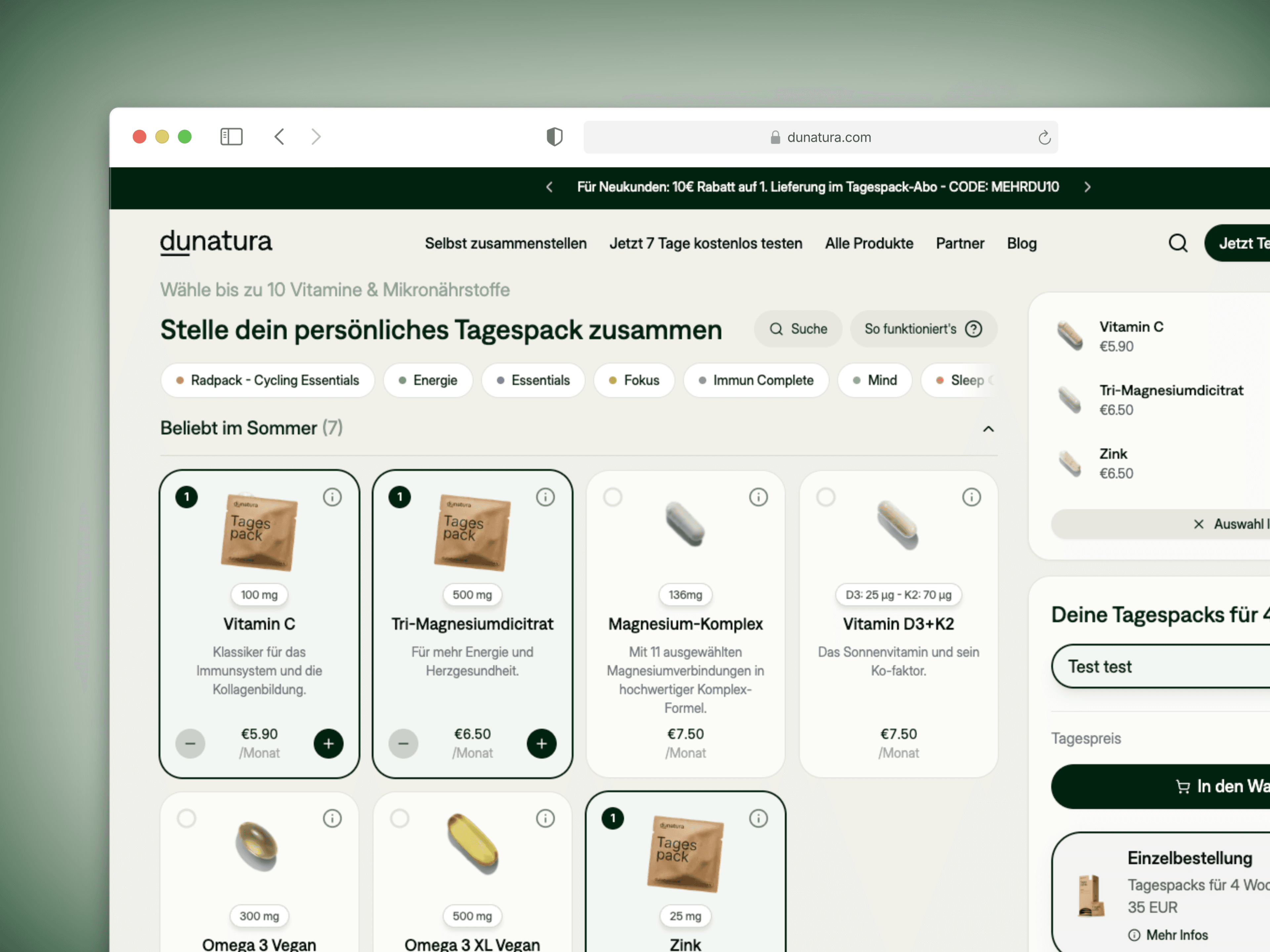
dunatura started, like many ecommerce brands, with Shopify’s free Dawn theme.
At first, it was exactly what we needed. It was fast to launch, easy to manage, and good enough to start selling.
As we got our first customers, we started customising it. We hired designers, worked with an agency, added new sections, installed more apps, and gradually turned it into a custom Shopify theme. That cost us thousands of dollars and the back-and-fourth with agencies cost us a lot of time too.
But even with all that work, the store never really felt custom.
dunatura sells personalised combinations of supplements. The two main sales funnels are a health questionnaire, which recommends a personalised plan, and a configurator where customers can build their own supplement pack.
Trying to build these funnels inside a Shopify theme meant constantly working around a system designed primarily for standard product pages and purchasing experiences.. The questionnaire, configurator, subscription logic, and storefront all relied on different apps, scripts, and custom code. They looked and behaved like separate systems instead of one coherent customer journey.
Our designer made amazing designs, but the implementation was usually a lot worse, just because it wasn't possible within Shopify's constraints.
Why we decided to rebuild
At some point, continuing to modify the existing theme no longer made sense.
Every new improvement added another layer to a system that was already difficult to maintain. We could keep paying agencies to patch individual problems, or we could rebuild the storefront around the experience we actually wanted to create.
So this is what I did! And I chose to do it headless.
What does “headless” mean?
In a traditional Shopify store, the frontend customers see and the ecommerce backend are closely connected through a Shopify theme.
A headless store separates the two: Shopify is still used for products, customers, orders, payments, discounts, and checkout. But the website itself is a separate application that communicates with Shopify through its APIs.
Shopify runs the commerce infrastructure, but we are no longer limited by its theme system when building the customer experience. This gave us much more control over the design, performance, content, and functionality of the store.
Building one coherent experience
The biggest improvement was that we could finally build the questionnaire, recommendations, configurator, and storefront as one connected application.
A customer could complete the questionnaire, receive a recommendation, understand why certain supplements were selected, adjust their pack, and continue to checkout through one consistent experience. That was especially important for dunatura because our product requires more explanation than a conventional ecommerce product.
Improving conversion
The goal was not only to make the website look better. It also had to sell better.
With the old setup, making changes to the funnel was slow. A relatively simple experiment could require changes to the theme, questionnaire, configurator, and subscription app.
With the new architecture, we could treat the entire purchasing journey as one funnel. We could improve how questions were presented, how recommendations were explained, how customers configured their packs, and how they moved towards checkout.
We could also build landing pages for different audiences and campaigns without being restricted by the sections available in a theme.
Just as importantly, we gained full control over analytics and tracking: Instead of relying only on events exposed by Shopify themes and apps, we built custom trakcing solutions that gathered massive amounts of data across the whole customer journey. This allowed us to make changes to massively increase CVR.
Themes are still the right place to start
I would not recommend that every new ecommerce brand build a headless store.
Shopify themes are excellent for launching quickly, testing an idea, and getting the first customers without making a large technical investment.
But as you scale your brand, those requirements might change. At the beginning, speed matters more than having a perfectly custom storefront. But in a later stage, relying only on apps, scripts, and agency-built workarounds can become more expensive than building the right system in-house.
I help a few founders with their stores & tech set up. If you need help, please reach out!
Cheers
- Manuel